Markdown mistakes are cheaper to fix before they enter a repository. Once a README update, changelog entry, or docs note is committed, the review conversation often shifts from the content itself to small rendering problems: a table broke, a heading level jumped, a link label is empty, or a code fence lost its language.
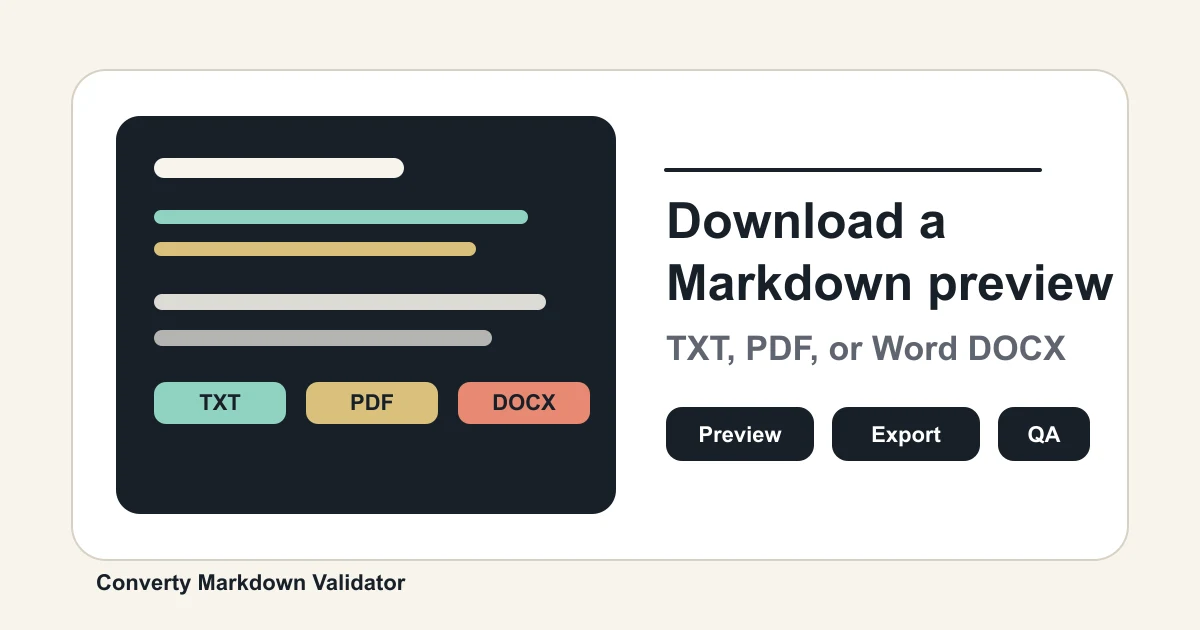
A GitHub-flavored Markdown preview gives you a fast check before that happens. It does not replace final review in the destination system, but it catches the problems that are easiest to miss while writing quickly. Converty’s Markdown Validator combines a live preview with focused warnings for common authoring issues.
Why GitHub-flavored Markdown needs its own preview pass
GitHub-flavored Markdown includes practical syntax that many technical teams rely on, including tables, task lists, code fences, links, and inline HTML handling. A plain text editor can help you write the content, but it may not show how those elements will render.
That matters because the visual shape of a Markdown document affects review. A table that looks aligned in source can still render poorly. A heading hierarchy that feels obvious while writing can become confusing after conversion. A code fence without a language label can make examples harder to scan.
The preview pass is not about polishing every sentence. It is about making sure the document behaves like a readable Markdown page before it reaches the next workflow.
A practical pre-commit Markdown workflow
Use the browser preview while the document is still easy to change.
- Open the Markdown Validator.
- Paste the README section, docs update, changelog entry, or release note.
- Review the rendered preview for layout surprises.
- Read the warning list for heading jumps, duplicate H1 usage, missing image alt text, empty links, and unlabeled code fences.
- Fix the source document before committing or pasting it into the final system.
This workflow is intentionally short. You are not moving docs into a new authoring platform. You are giving the Markdown one focused inspection pass before the repository becomes the review surface.
What the preview can catch early
A useful Markdown preview should help with the mistakes that slow reviews down:
- tables that do not read cleanly
- headings that skip levels
- multiple H1 headings in one document
- links without useful labels
- images without alt text
- code fences without language labels
- raw HTML that should be treated carefully
Those checks are especially useful for technical content because small structure issues can make examples harder to trust.
When the browser preview is not enough
The browser preview is an early check, not the final source of truth for every docs platform. If your final destination uses custom components, special Markdown extensions, or product-specific rendering, you still need to review the page in that environment.
That boundary is important. Converty is useful before the heavier system takes over. It gives writers, developers, and reviewers a fast way to catch ordinary Markdown issues without waiting for a docs build or pull request review.
For broader content QA guidance, read How to Catch Markdown Issues Before Publishing. For team handoffs, continue with How Product and Docs Teams Can Review Markdown Without Losing Formatting.
Open the Markdown Validator before committing Markdown when you want the preview and warnings in one place.