Markdown review often ends with a practical question: how do you share the result with someone who should not have to read the source? Raw Markdown is useful for authors and developers, but it is not always the best format for a product manager, client, editor, or stakeholder who only needs to inspect the rendered content.
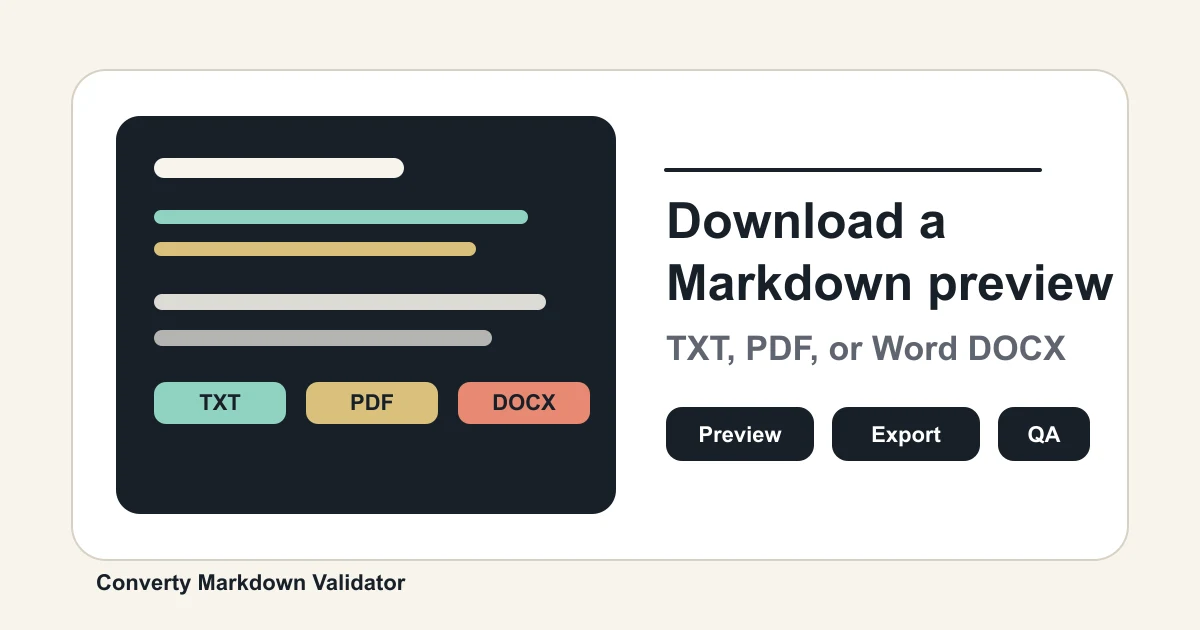
The Markdown Validator now includes a compact download menu for the preview. From that menu, you can export the rendered result as TXT, PDF, or Word DOCX while keeping the source Markdown download as a separate action for the actual .md content.
Rendered preview versus source
Preview exports are generated from the sanitized rendered HTML. That means the exported file follows the text and structure shown in the preview panel, not the raw Markdown source directly. If a reviewer needs to read headings, paragraphs, tables, or links as an end reader, the preview export is the right file. If a developer needs to commit or preserve the Markdown source, the Markdown download remains the accurate source file.
Which format to use
- TXT is useful for quick copy review, search, archiving, or systems that accept plain text.
- PDF is better when you want a stable file for reading, sharing, or approval.
- Word DOCX fits when an editor or client expects comments and copy edits in a document workflow.
What is preserved
The exports prioritize readable document output rather than a pixel-perfect browser preview. They preserve headings, paragraphs, lists, tables, code blocks, blockquotes, links, image alt text, and extracted KaTeX text where available.
A practical workflow is short: paste the Markdown, inspect the preview, fix any warnings, open the download menu, and choose TXT, PDF, or Word based on the next reviewer.
For a broader Markdown QA pass, read How to Catch Markdown Issues Before Publishing. If you are checking content before a commit, use the GitHub-flavored Markdown preview workflow. For team review, pair this with the product and docs handoff workflow.